
[Japanese Driving Lesson Review] Learning to Drive in NZ With a Japanese Coach – Is It Worth It?


To get straight to the point —
When you drive in New Zealand for the first time, who teaches you, and what they teach you
is far more important than most people expect.
This is something I genuinely came to appreciate through this experience.
My eldest son recently took a driving lesson with JDM Driving Academy (“JDM”), and this article is a first-hand review of that experience.
This page is made for those who are about to start driving in New Zealand, and for anyone looking for a lesson where they can learn safely and confidently in Japanese and in English.
【Contents】
- Driving Instructor Introduction | Yuta
- Overview / Summary of JDM Driving Lessons
- [Experience Review] The Actual Lesson Flow
- Who JDM Driving Lessons Are Recommended For
- Two Common Misunderstandings About NZ Road Rules
- JDM Driving Lessons | How to Enquire
By the time you finish reading, you’ll have a clear idea of whether this is something worth considering for yourself.
Note: The content of this page was reviewed by Yuta in advance before publication.
1. Driving Instructor Introduction | Yuta

The instructor who took care of the lesson this time was Yuta.
He has a very calm and reassuring presence, and his explanations were consistently clear and easy to understand.
Once again, I was reminded just how reassuring it is for beginners to be able to communicate in Japanese while learning to drive.
Yuta holds New Zealand instructor qualifications for everything from standard cars to trucks and buses (Class 1–5).
He also holds qualifications to act as a practical driving test examiner, meaning his knowledge and experience in this field are unquestionably top-class.
A Calm Personality That Instils Confidence
When you’re not yet confident behind the wheel, it’s easy to feel nervous.
Having an instructor who creates a calm, steady atmosphere makes a huge difference.
What stood out most was how Yuta took the time at the very start to create an environment where my son could relax and drive with confidence.
Questioning “Intimidating Teaching” as a Starting Point
Through his own experience, Yuta felt uncomfortable with how many driving instructors in New Zealand rely on overly harsh or intimidating teaching styles.
He began to think, “Surely it’s possible to teach driving in a kinder, more supportive way.”
That belief, combined with his love of driving, ultimately led him to become a driving instructor.
Why I Chose JDM
At the time of searching, JDM was the only place I could find offering driving lessons by a Japanese instructor.
Although I drive regularly in New Zealand myself, I wanted my son — especially at the very beginning — to develop safe driving habits and sound judgement from a professional perspective.
That’s why I decided to engage JDM.
Reference:
Partnership With a Major Truck Manufacturer

(Photo provided by Yuta)
One notable point demonstrating Yuta’s track record is his partnership with a major truck manufacturer.
This strongly suggests that his expertise and credibility — particularly in the heavy vehicle field — are highly regarded within the industry.
2. Overview / Summary of JDM Driving Lessons

While Yuta’s main work is providing truck training for a major partner manufacturer, he kindly accepted this private lesson request.
Following my son’s recent success in passing the theory test and obtaining his Learner Licence, we arranged a one-hour Class 1 (standard car) lesson.
In addition, prior to the lesson, I had already taught him the bare minimum basics and practised together early in the mornings in empty car parks and around the neighbourhood.
Q. What Is a Learner Licence?
- Minimum age: 16
- Key conditions: Must display L plates; a full licence holder must accompany the driver
- Purpose: To learn basic vehicle operation and road rules
JDMと大手ドライビングスクールの比較
| JDM | Large Driving Schools | |
| Lesson structure | Aim to pass practical tests in as few lessons as possible (from 1 lesson) |
Multiple lessons are the norm |
| Pricing | Reasonable and fair | Around industry average |
| Teaching style | Calm and careful | Reviews often mention “strict” or “intimidating” |
| Training vehicle | Dual brake and accelerator on passenger side | Usually brake only |
Lesson Course Overview
- Coverage area:
All of Auckland - Lesson options:
From 1-hour single lessons (all classes). Package options available for Class 1 and 2 (e.g. 1 hour × 5 lessons) - Licence types:
Cars, trucks, buses (Class 1–5)

Lesson Details This Time
- Date: January 2026
- Lesson type: Class 1 (standard car), one 1-hour session
- Vehicle: Automatic, with both brake and accelerator on the passenger side
Q. Why Is a Passenger-Side Accelerator Important?
Having an accelerator on the passenger side allows the instructor to move the vehicle themselves in situations such as:
- Trouble occurring in the middle of an intersection or motorway
- The learner panicking mid-drive

I initially chose JDM because of the added safety of a passenger-side brake, but I was genuinely surprised (in a good way) to learn the vehicle also has an accelerator.
What We Felt After the Lesson
Both my son (who was driving) and I (sitting in the back seat) felt the following:
- Instructions were clear and logical, with reasons explained for each action
- Yuta’s calm demeanour significantly reduced driving stress
- He was open and patient with questions
- Learning test criteria using actual evaluation charts greatly eased anxiety about the practical exam
Reference:
My Son’s Actual Review

(Source: Google)
All 19 Google reviews for JDM are rated 5 stars at this moment, which clearly reflects how highly regarded Yuta’s lessons are.
3. [Experience Review] The Actual Lesson Flow
Let’s take a look at how the lesson unfolded on the day!
Note: This is just one example. Lesson content can vary significantly depending on goals and skill level.
① Meeting on Site

We met at a pre-arranged location.
This time, Yuta came to our home area, allowing practice in familiar daily driving conditions, which we really appreciated.
② Mirror Adjustment
(Using Tablet Images)

Seat and mirrors were adjusted first.
Yuta used photos on a tablet to show exactly how mirrors should be positioned from the driver’s viewpoint, making it very easy to understand.
③ Basic Controls

He then explained vehicle controls calmly and clearly, which was ideal for a beginner in an unfamiliar car.
④ Starting to Drive
After one lap around the neighbourhood, Yuta asked if anything felt difficult.
When my son said it was hard to judge distance from the kerb, Yuta explained how a piece of black tape on the dashboard could be used as a reference point to avoid mounting the kerb.

As above, I believed that this kind of lesson-specific support was extremely helpful.
After that, they practised U-turns, three-point turns, main roads, and roundabouts — an essential NZ driving skill.
⑤ Passing Parked Cars
(Correct Indicator Use)

Both my son and I found indicator use when passing parked cars particularly difficult.
Road width, centre lines, and traffic conditions all affect indicator use, which can be confusing for beginners.
Incorrect indicator use results in test deductions.
So learning this from someone who also acts as an examiner is a major advantage.
⑥ Parallel Parking Practice

With clear explanations beforehand, my son performed surprisingly well on his first attempt.
After minor adjustments, the second and third attempts were smooth and accurate.
⑦ Motorway Driving

Motorway driving is one of the most important aspects of NZ lessons.
Thanks to Yuta’s guidance, merging and exiting the motorway went smoothly.
⑧ Practical Test Criteria Explained

Personally, this was the most valuable part.
For example, when checking blind spots after indicating, Yuta explained exactly how much to turn your head so it’s clearly visible to the examiner.
⑨ Final: Advice for the Practical Test
At the end, Yuta summarised likely challenge areas and what to focus on during practice.
I firmly believe how you practise matters as much as how much you practise, and this lesson provided clear direction for next steps.
Reference:
Indicator Rules Even Experienced Drivers Struggle With
Additional scenarios covered included:
- Passing parked cars (with or without centre lines)
- U-turns at dead ends
- Three-point turns
Even as an experienced driver, this was a valuable refresher for me.
4. Who JDM Driving Lessons Are Recommended For
Based on this experience, JDM is especially suitable for:
- Those who want to learn driving in New Zealand in Japanese
- Beginners who want to build safety-first fundamentals
- Parents practising with their children but wanting professional feedback
- Anyone unsure about local road rules
- Drivers who feel anxious and want a calm learning environment
If several of these apply, reaching out for a consultation may bring peace of mind.
Exceptional Reassurance After the Lesson
Self-taught driving can work to a point, but the reassurance that comes from learning proper safety habits early is invaluable — especially when it’s your family member driving.
5. Two Common Misunderstandings About NZ Road Rules
Here, I’d like to introduce two common misunderstandings about New Zealand road rules, based on what we learned during this lesson.
1) A Common Misunderstanding About Stop Signs
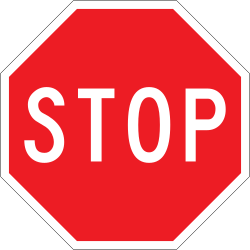 (Source: wikipedia)
- Common misunderstanding:
You must stop before the stop line. - Correct road rule:
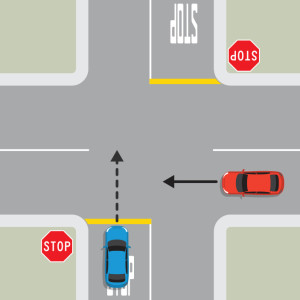
You must stop at a position where you can clearly see traffic coming from all directions.
For example, if parked cars, buildings, or trees prevent you from clearly seeing approaching vehicles, it is acceptable to stop past the stop line.
Understanding this rule correctly helps you stay calm during the practical driving test, especially in situations where visibility to the left or right is poor if you stop strictly before the line.
Reference:
What Is the Correct Rule?
According to the NZTA official website, the rules are as below,
Driving up to an intersection
If any other vehicle is approaching or crossing an intersection, don’t speed up as you approach. Use the system of car control to help you deal with hazards safely.
- Course – look ahead for a safe and legal path.
- Mirrors – look behind and in your blind spots.
- Signal – for at least 3 seconds if turning.
- Brakes – slow down so you can give way if required.
- Gears – change if necessary.
When it’s safe:
- Accelerate – up to traffic speed.
The red shading in the diagram below shows you which areas to check carefully before entering an intersection.
(Source: NZTA)
2) A Common Misunderstanding About Bus Lanes

(Source: NZTA)
- Common misunderstanding:
You are never allowed to drive in a bus lane. - Correct road rule:
You may use a bus lane for the minimum distance necessary, up to 50 metres, when required.
For example, if there is a bus lane just before or immediately after the intersection where you need to turn, it is legal to use the bus lane as long as it is within 50 metres.
Reference: What Is the Correct Rule?
To drive more safely and confidently, it’s a good idea to check official sources if you are unsure about road rules.
The Auckland Transport (AT) website explains bus lane rules as follows:
Bus Lane / General rules
- Vehicles must not stop or park in any bus or transit lane unless they are permitted to use the lane or the vehicle is an emergency vehicle that is being used in an emergency and is operating its beacons, for example, an ambulance, police car or fire engine.
- You must only use a bus or transit lane for the minimum length necessary, and no more than 50 metres.
- If using the bus or transit lane to turn or for another manoeuvre, you must give way to all vehicles entitled to use that lane.
(Source: AT)
In addition, this rule also applies to T2 and T3 transit lanes.
 (Source: NZTA)
Learn the Correct Road Rules for Safer Driving
“Drive Road Code”

(Source: Drive)
If you want to better understand New Zealand road rules, Drive Road Code is a very useful official resource operated by a New Zealand government agency.
It’s worth noting that even large driving schools may occasionally provide incorrect or outdated information, so developing the habit of checking official sources yourself is strongly recommended.
【Drive Road Code: Official website】
https://drive.govt.nz/learner-licence/road-code
6. JDM Driving Lessons | How to Enquire

The most reliable way to contact JDM is via their official website or email:
Email:
jdmdrivingschoolauckland@gmail.com
When enquiring, it helps to share:
- Preferred area and schedule
- Learning goals (basics, road rules, parking, test prep, etc.)
- Driving experience level
From the Ask Me NZ Team
In New Zealand, having a car greatly expands your freedom and quality of life.
Because road rules differ from Japan, it’s natural to feel anxious at first.
If you’re considering professional lessons, JDM Driving Academy is well worth contacting!
\ 最新情報をチェック /

